The Muslim World League Commends Global Engagement on the International Day to Combat Islamophobia and Calls for Legislative Action
Makkah:
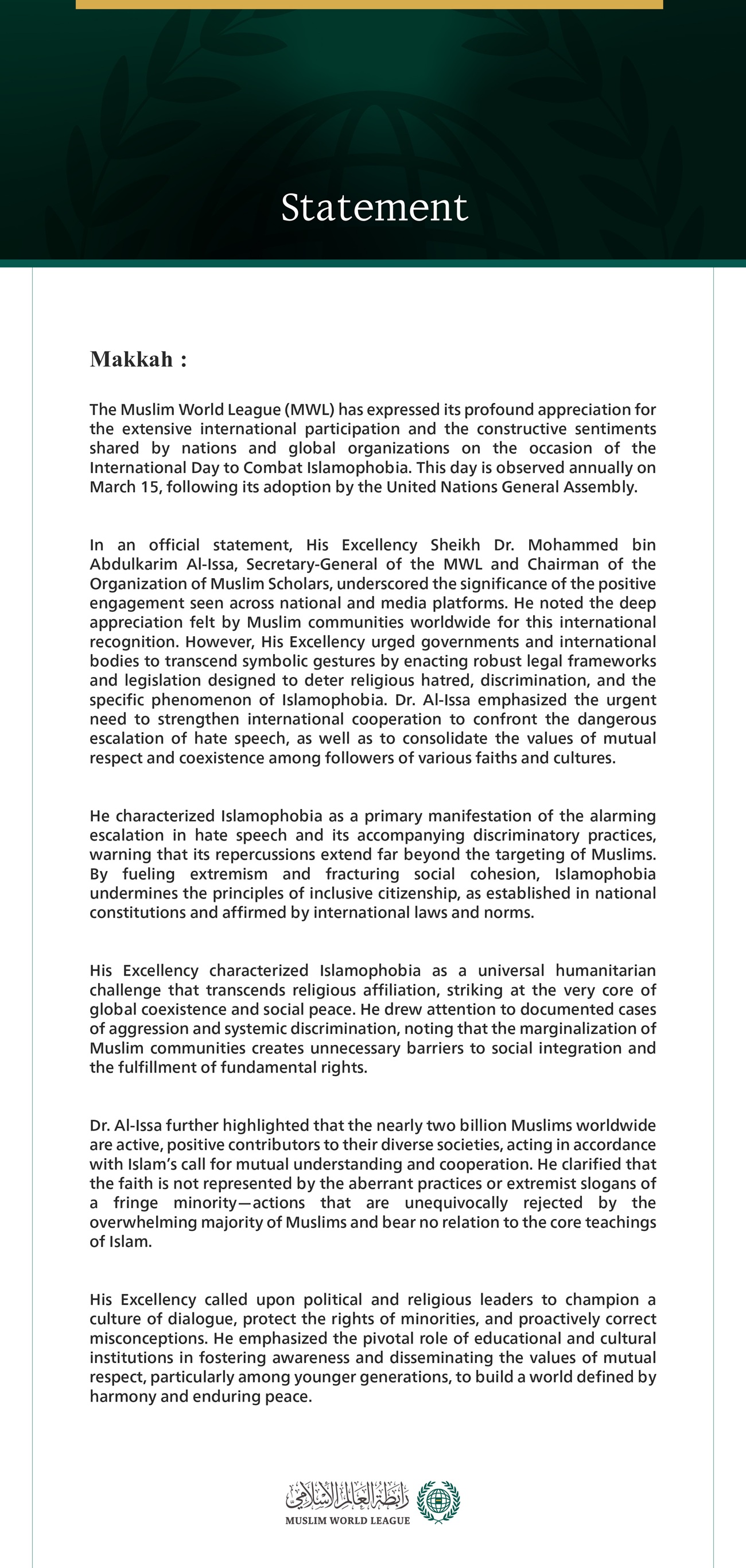
The Muslim World League (MWL) has expressed its profound appreciation for the extensive international participation and the constructive sentiments shared by nations and global organizations on the occasion of the International Day to Combat Islamophobia. This day is observed annually on March 15, following its adoption by the United Nations General Assembly.
In an official statement, His Excellency Sheikh Dr. Mohammed bin Abdulkarim Al-Issa, Secretary-General of the MWL and Chairman of the Organization of Muslim Scholars, underscored the significance of the positive engagement seen across national and media platforms. He noted the deep appreciation felt by Muslim communities worldwide for this international recognition. However, His Excellency urged governments and international bodies to transcend symbolic gestures by enacting robust legal frameworks and legislation designed to deter religious hatred, discrimination, and the specific phenomenon of Islamophobia. Dr. Al-Issa emphasized the urgent need to strengthen international cooperation to confront the dangerous escalation of hate speech, as well as to consolidate the values of mutual respect and coexistence among followers of various faiths and cultures.
He characterized Islamophobia as a primary manifestation of the alarming escalation in hate speech and its accompanying discriminatory practices, warning that its repercussions extend far beyond the targeting of Muslims. By fueling extremism and fracturing social cohesion, Islamophobia undermines the principles of inclusive citizenship, as established in national constitutions and affirmed by international laws and norms.
His Excellency characterized Islamophobia as a universal humanitarian challenge that transcends religious affiliation, striking at the very core of global coexistence and social peace. He drew attention to documented cases of aggression and systemic discrimination, noting that the marginalization of Muslim communities creates unnecessary barriers to social integration and the fulfillment of fundamental rights.
Dr. Al-Issa further highlighted that the nearly two billion Muslims worldwide are active, positive contributors to their diverse societies, acting in accordance with Islam’s call for mutual understanding and cooperation. He clarified that the faith is not represented by the aberrant practices or extremist slogans of a fringe minority—actions that are unequivocally rejected by the overwhelming majority of Muslims and bear no relation to the core teachings of Islam.
His Excellency called upon political and religious leaders to champion a culture of dialogue, protect the rights of minorities, and proactively correct misconceptions. He emphasized the pivotal role of educational and cultural institutions in fostering awareness and disseminating the values of mutual respect, particularly among younger generations, to build a world defined by harmony and enduring peace.